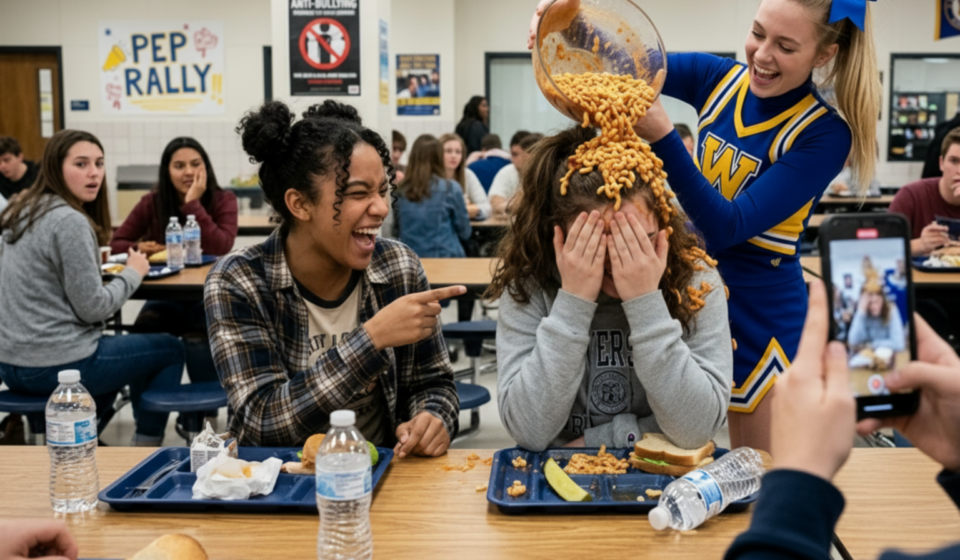
The Macaron Trap: When the “new” hid a secret
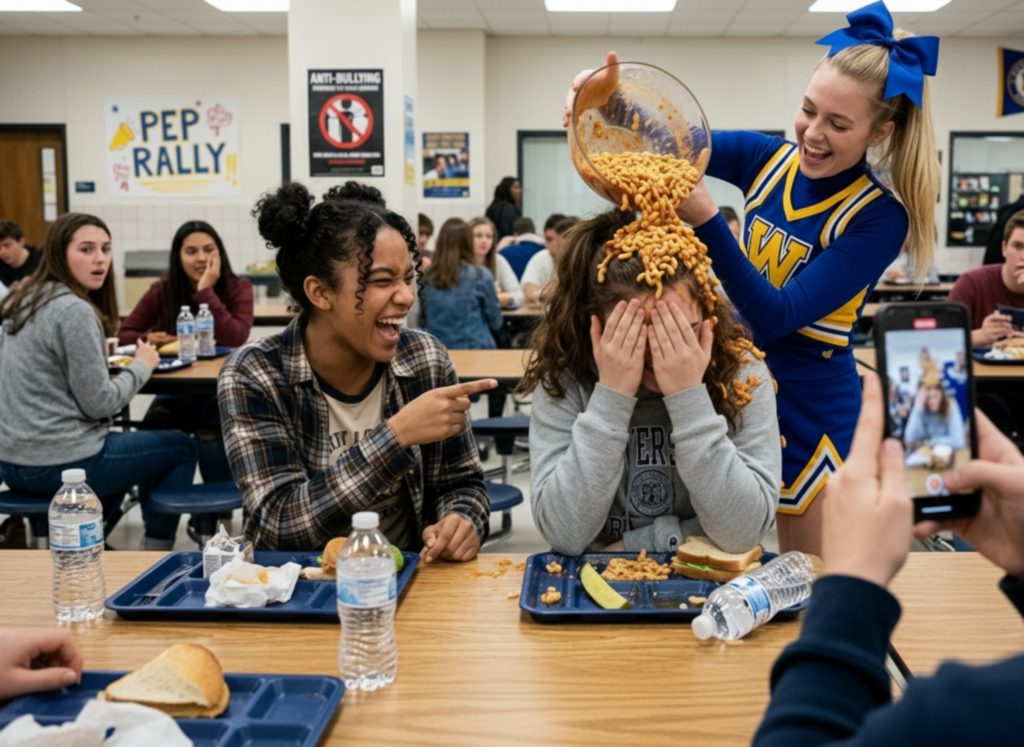
Part 2: The Fall of the Untouchables
The silence in the cafeteria wasn’t just calm—it was heavy, suffocating. Madison’s arrogant smile didn’t just fade; it disintegrated. The girl she’d treated like a disposable rag was the daughter of the man who held her entire athletic future in his hands.
“Coach, I… I didn’t know,” Madison stammered, her voice trembling for the very first time.
“That she was my daughter?” Coach Harrison’s voice was a low, dangerous rumble. “Or didn’t you know someone was watching?”
He didn’t wait for an answer. He pulled off his tracksuit jacket and wrapped it around Maya’s shivering, sugar-stained shoulders. The fabric was warm and smelled homey—a stark contrast to the sticky, colorful mess ingrained in her clothes. As Maya walked away, she felt hundreds of eyes on her—not with the usual jeers, but with the sudden, brutal realization that the era of “penny girls” had just crashed into a brick wall.
The fallout was a storm. An hour later, the principal’s office was a battleground of exorbitantly priced lawyers and parents in designer suits. Madison’s mother paced the room, her voice high-pitched: “They’re only a few cookies! We’ll buy her ten new dresses! This shouldn’t mess up my daughter’s chances at the state championships!”
But Coach Harrison remained seated behind the desk, his face as hard as granite. “It was never about macarons,” he said quietly. “It was the look in your daughter’s eyes when she thought she could break a human being for fun. My daughter wanted to be ‘just Maya’ here. You made that impossible. Now I’m making sure your daughter understands the weight of her actions.”
The consequences were absolute. Suspension. A permanent notation on their records. And the most devastating blow: immediate and non-negotiable dismissal from the cheerleading squad. Madison’s college scholarship dreams vanished the moment she signed a piece of paper.
The following weeks were a slow and painful transformation for the school. Without their “Queen,” the culture of fear began to evaporate. But the most poignant moment came a month later.
Maya saw Madison sitting alone in a remote corner of the cafeteria. No entourage. No fancy coffee. Just a girl staring blankly at a tray of food she wasn’t touching. Her “ The “invincibility” was gone, replaced by a hollow, broken stare.
Maya approached. The cafeteria fell silent again, expecting a confrontation—a final “victory lap.” Instead, Maya pulled up a chair and sat down.
“Why are you sitting here?” Madison whispered, her eyes red. “After what I did… you should be laughing at me.”
“I don’t get any pleasure from seeing people broken, Madison,” Maya said, her voice firm and kind. “I know what it’s like to have nothing. Now you do too. But the difference is, this time you can build something real. You don’t have to be the one who destroys everything.”
Madison looked at Maya and, for the first time, she didn’t see a “target.” She saw a person. A single tear traced a path through her makeup. “I’m so sorry,” she finally blurted out, her voice choked with emotion. It was the first honest word she’d spoken in years.
Maya kept the stained dress at the back of her closet. She never wore it again, but she looked at it whenever she felt fear. The colored stains were a scar, a reminder that while the world can be cruel, there is a fierce, protective love that sustains the weak—and that sometimes, the only way to truly win is to reach out to the person who tried to bring you down.