The Filter of Humanity: A Story of Steel and Gentleness
Part 2: The Full Story
I had just walked in to buy a furnace filter and watched a young mother being humiliated over formula, until an old steelworker said what no one else dared.
“Try again, please,” the girl whispered. Her voice was so faint I almost didn’t hear her over the noise of the scanners and carts. The cashier tried. Refused.
He tried again. Refused.
She stood there in faded clothes, with a baby strapped into the cart seat, dangling one hand over the handle as if simply keeping it moving would prevent it from collapsing. On the conveyor belt were three cartons of milk, a gallon of milk, and a box of cheap cereal. That was it. No junk food. No makeup. No extras. Just the kind of shopping that tells you someone’s already cut everything there was to cut.
My name is Arthur Donovan. Seventy-four years old. Army veteran. Retired steelworker. I live in western Pennsylvania, in a town where the factories once lit up the night sky. Now the buildings are empty, the jobs are gone, and half the people I know are counting their pills and dollars on their kitchen table before deciding what’s most important this week.
I was only there for a furnace filter. My house cools down quickly, and at my age, the cold seeps into your bones as if it owned the place.
Then the baby started to cry. Not loudly at first. Just tired. Hungry. The kind of cry that makes decent people roll their eyes. The young woman swiped her card again. Refused again. She stared at the screen as if looking more closely might change the machine’s mind.
Behind me, someone sighed heavily. Then, the man further down the line said, “If you can’t afford to feed a baby, don’t have one.”
Everything stopped. The young woman froze. She couldn’t have been more than twenty-two. She had dark circles under her eyes, and her hair was tied in a messy knot. On one sleeve of her top, there was something dried—milk or spit-up, or maybe just the remnants of a day too long for one person to handle.
She reached for the boxes and began to pull them off the mat. “I’ll just get the milk,” she said, and I swear she was trying not to cry in front of strangers.
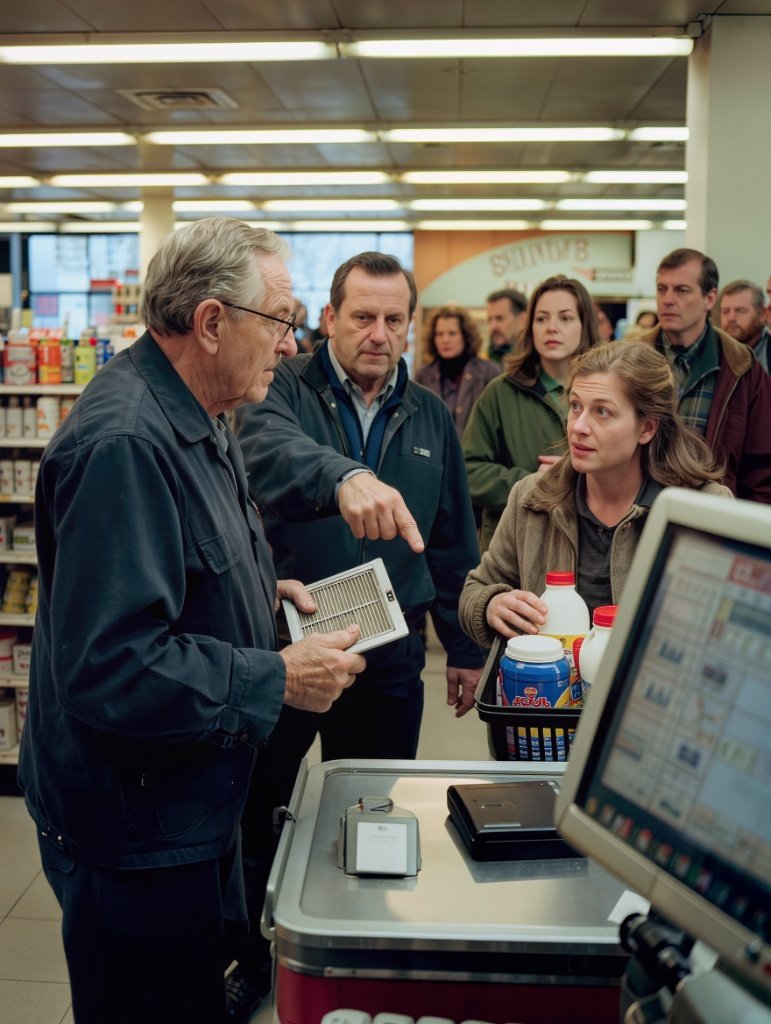
The man continued. People like him never stop. “The whole line has to wait because no one plans anything anymore,” he said. “And then we’re supposed to feel sorry for them.”
A woman near the candy aisle chimed in: “Oh, for goodness’ sake, leave her alone!” Another man grumbled: “No one helps the workers either.”
And suddenly, the whole line broke apart. Not because of the milk. Not because of the baby. Because of anger. People wear anger like a garment these days. Anger at money. At rents that are too high. At doctors’ textures. At jobs that disappeared and never came back. At the feeling of being invisible.
I know this anger. I brought it back from the war. I carried it through layoffs, funerals, union meetings, and the long winters after my wife died. My wife, Ellen, used to say that the country becomes vicious when people are afraid.
Standing there, I thought of her. I thought back to the time our youngest got pneumonia and we stayed up half the night deciding what texture could wait. I thought of Ellen’s ashamed look when a pharmacy clerk once told her our card wouldn’t work. I can still remember that look. It wasn’t poverty; it was humiliation.
This girl in front of me had that same look. So, I took out my wallet. My pension isn’t huge. My savings are more modest than they should be. I count every liter of gas and every trip to the grocery store, like most of the old people I know. But I also know what a hungry baby’s cry sounds like.
I took out my card. “Swipe all of this,” I said.
The girl spun around so fast she almost knocked over the cart. “Sir, no,” she said. “I can’t let you do that.” “Yes, you can.”
The cashier looked at me as if to make sure I was serious. “I said: scan all of this,” I repeated. “All of it.”
The man in the back sneered. “You’re part of the problem.”
I turned and looked him straight in the eye. Maybe it was the army man left in me. Maybe the old union man. Or maybe just grief with nowhere else to go. “No,” I said. “The problem is grown men brutalizing exhausted women for formula.”
He puffed out his chest. I took a step toward him. I’m old, but I’m still tall, and some things about a man don’t just disappear because his hair turns gray. “You know nothing about her,” I said. “Absolutely nothing. You don’t know if she just finished a double shift. You don’t know if the baby was sick. You don’t know if she slept last night. All you know is that you saw someone weaker than you and decided to feel powerful.”
No one said a word. Even the baby was silent. The man looked for support and found none. He muttered something insulting under his breath, abandoned his cart, and left.
Then the young woman began to cry for real. Not loudly. Just the kind of crying that comes when you’ve held on too long. “Thank you,” she said. “I was sure the delivery would have arrived. My son can’t tolerate regular milk. I worked the night shift and…” “You don’t owe me your story,” I told her. She closed her mouth and nodded. “Just go feed your little boy.”
She left clutching the bag to her chest as if it contained oxygen. I paid for my filter and went home, thinking it was over. It wasn’t.
Someone had filmed the whole thing. That same evening, my daughter called me and said, “Dad, your face is everywhere.” The next morning, strangers were arguing about me as if I were public property. Some called me a hero. Others an idiot. Some were using this girl and this baby to prove points they already wanted to prove.
I turned off my phone. I didn’t want praise. I certainly didn’t want the noise.
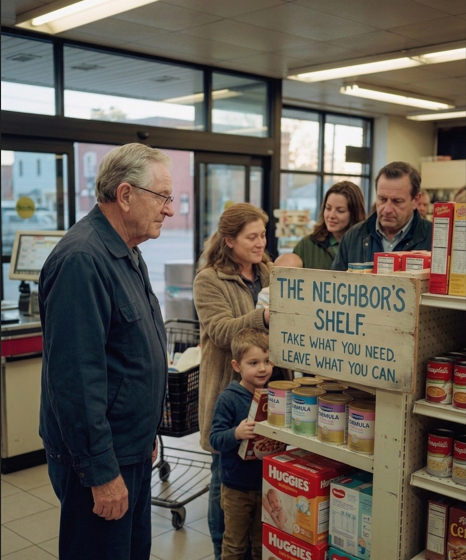
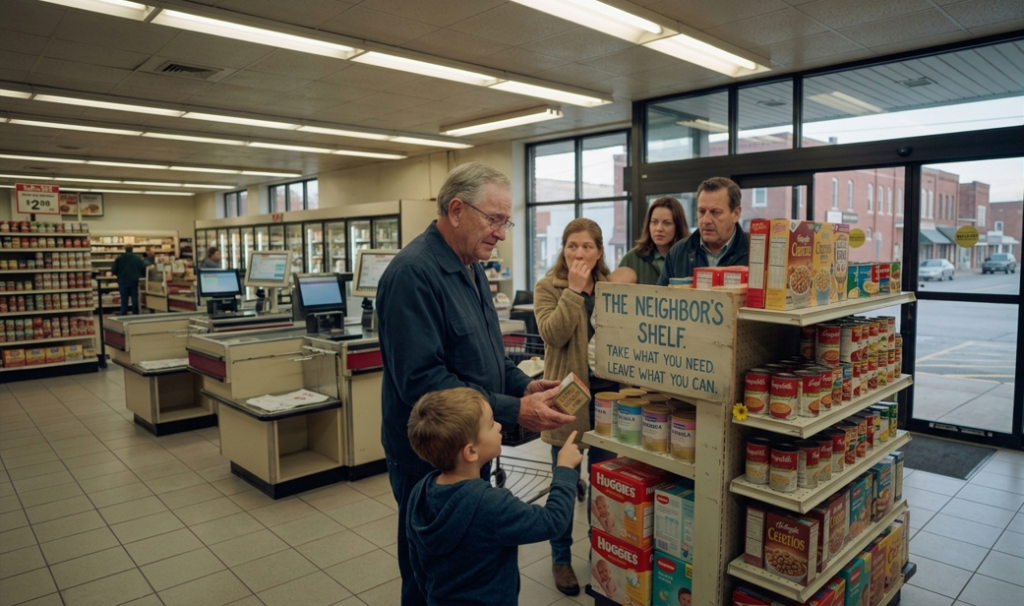
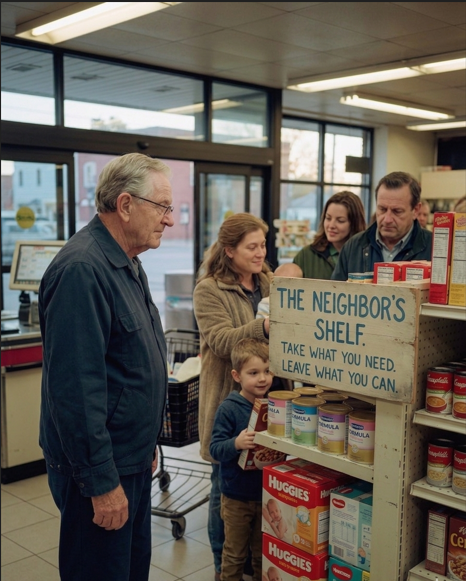
A week later, I went back to get my blood pressure medication. Near the front doors, where they usually stack patio chairs and bags of mulch, there were two plastic shelves and a hand-painted sign:
NEIGHBOR’S SHELF
Take what you need. Leave what you can.
Diapers. Milk. Soup. Cereal. Toothpaste. Baby food. Pasta. More than I could count. The young cashier was restocking the shelves. “What’s all this?” I asked.
He smiled. “It started the day after you were here,” he said. “A woman left two cartons of milk at my register and said, ‘For the next mom.’ Then someone brought in diapers. Then soup. It hasn’t been empty since.”
I stayed there longer than I planned. The people in that store approached quietly, placed things in the bins, and moved on. No speeches. No lectures. No cameras. Just neighbors making sure another neighbor’s child had enough to eat.
My wife was right. People are afraid. So they become mean. But sometimes, if someone is brave enough to stop the meanness for even a minute, the others remember who they were before fear took over.
That’s what I saw in that store. Not charity. Not weakness. Not pity. Just people refusing to let each other starve. And these days, that seems like the most humane thing I know.