
No one took the waiter seriously… until he touched the piano and silenced the entire room.

No one took the waiter seriously… until he touched the piano and silenced the entire room 😲😲
The evening seemed perfect: crystal glasses sparkled under the chandelier, while the guests, dressed in silk and velvet, moved with quiet confidence, talking and laughing as if everything around them had always belonged to them. And among them stood a young waiter near the grand piano, holding a silver tray, invisible to all who passed by, because no one was really looking at him. He was simply part of the scenery, part of the service… until the moment he spoke.
“May I play something on the piano?”
For a brief moment, the room fell silent. Then laughter erupted. A man in a velvet tuxedo gave a mocking smile, not because the question was funny, but because it seemed out of place. Others followed with polite smiles, already relegating the moment to the status of an insignificant detail.
“You? Have you ever even touched a piano in your life?”
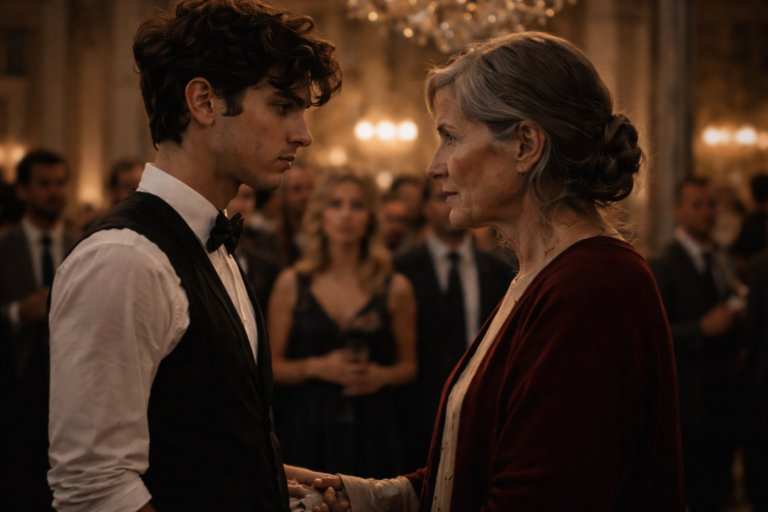
No one expected an answer—and none came. Instead, the waiter turned calmly, placed the tray beside the piano, and pulled out the bench. His movements were deliberate and assured, as if he no longer needed anyone’s permission. And then something subtle began to change. The conversations gradually faded, not all at once, but enough for people to begin to notice. There was something unusual about him, something that didn’t fit the role he was supposed to be playing. He didn’t seem nervous or uncertain. He looked like someone who knew exactly what was going to happen. The laughter stopped, more and more eyes turned toward him, the air became heavier, quieter, more tense. The young man sat down slowly, placed his fingers over the keys… and at that precise moment, the entire room seemed to hold its breath.
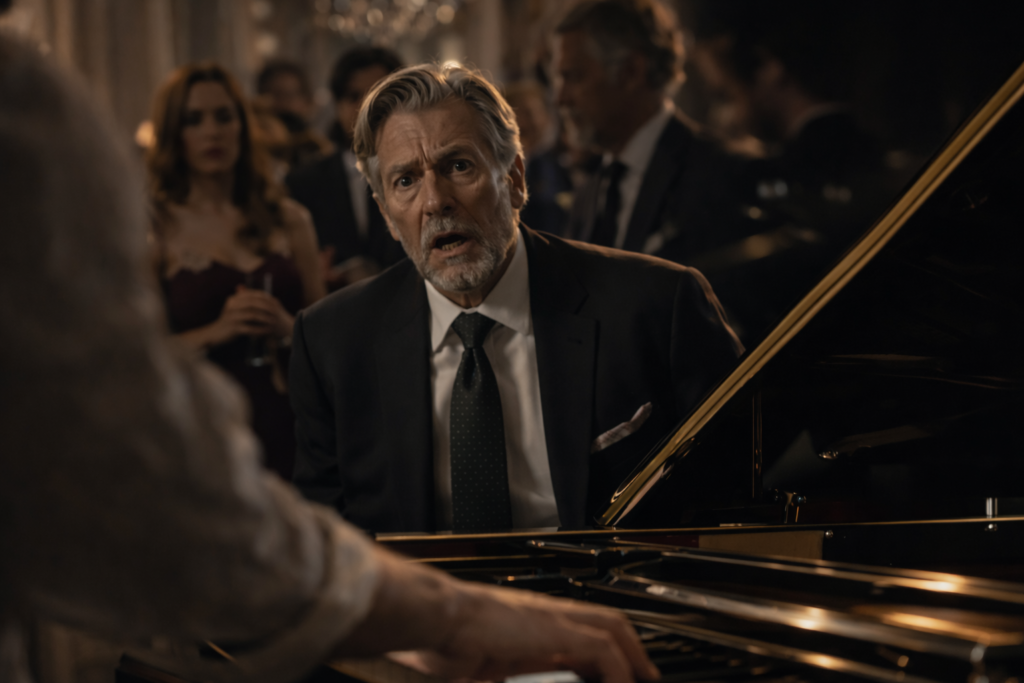
The room ceased to respect him the moment he asked permission—his first mistake. He stood by the black piano in a waiter’s jacket, holding the silver tray with practiced stillness, while the chandelier lent everyone else an air of importance, confidence, and untouchability. The guests in silk and velvet moved about freely, never mistaken for staff, for they had always belonged to the “right side” of the room. Then he spoke softly.
“May I play something on the piano?”
The man in the velvet tuxedo burst out laughing, not because it was funny, but because humiliation costs nothing to those who derive pleasure from it. A few guests smiled mechanically, already ready to forget the moment. But the waiter didn’t react. He simply turned, placed the tray beside the piano, and sat down. No announcement. No defense. No hesitation. Just certainty. Then his fingers touched the keys.
The first notes didn’t sound like an attempt to impress—they were like something opening up, something long hidden. Conversations dwindled… then vanished completely, as glances shifted unconsciously. The music filled the air with a silent precision, too intimate to be a coincidence, too familiar to be accidental. His hands moved with a mastery that came not just from talent, but from memory… and something deeper, forged by pain.
Then someone noticed his wrist: a small black tattoo of musical notes. The older man’s expression changed instantly. His mocking smile vanished as he stepped forward, as if drawn by the music itself.
“Wait… are you…?”
The pianist didn’t look up, but the melody changed slightly—and that was enough. The older man paled, for he recognized the tune. It was an unfinished composition written by his wife a week before her disappearance. At first, the guests thought he was reacting to talent—but they were wrong. He was reacting to a memory. The melody had never been published, never played, never shared beyond the walls of the house. It belonged to one woman, to one moment, to a closed room upstairs that no one had entered since her disappearance… and yet, it was being played to perfection.
“Who taught you that?”
The pianist’s hands didn’t stop, and the silence made the question even more weighty. Then, without looking up, he replied:

“The woman you told everyone had abandoned her family.”
The room fell completely silent—not out of curiosity, but out of understanding. The kind of understanding that spreads slowly before taking hold all at once. The older man’s voice grew tense.
“She never finished that piece.”
The pianist looked up for the first time, and his calm expression was more unsettling than anger.
“No, she didn’t finish it.”
After a short pause, he added:
“She ran out of time after you broke her right hand.”
No one moved. The words settled in the room like something irreversible. The older man tried to reply, but his voice had lost all its strength.
“That’s a lie.”
But it was too late… and it sounded too weak, because the truth had already begun to emerge. The innocent deny the acts, the guilty deny the stories.
The pianist rose slowly, and now everyone could see him clearly. The tattoo on his wrist corresponded to the opening notes of the composition… as well as to the notes framed in the portrait above the fireplace—the portrait of the missing woman. And suddenly, he no longer looked like a mere member of staff… but like something else. Something inevitable.
“She didn’t leave you a son in secret.”
The older man stopped breathing. The pianist’s voice remained calm:
“She left you a witness.”
Silence completely filled the room. Then a sound came from the staircase—light, but impossible to ignore. Every head turned at once.
And there she was.
Older, thinner, her right hand in a splint… but alive.
The woman stepped forward slowly, and at that moment, the illusion that had held the room together completely crumbled. The man in velvet stepped back, trying to speak, but no words came out. Finally, she spoke softly:
“I had no more time… but no more truth.”
The young man stepped aside—no longer like a waiter, but like someone who had accomplished his mission. And for the first time that evening, the room no longer saw him as invisible… but as the one who had brought the truth into the light.